
Lattice Multiplication Method –Step-by-Step Examples, Worksheet, Video
Subscribe to our ▶️ YouTube channel 🔴 for the latest videos, updates, and tips.
Lattice multiplication is an easy visual method used to multiply large numbers. Instead of using the traditional long multiplication method, students draw a grid (called a lattice) and multiply one digit at a time. This method helps children organize their work, reduce mistakes, and understand place value more clearly. In this lesson, you will learn how to solve lattice multiplication problems step by step with clear diagrams, worked examples, and printable worksheets. Whether you are multiplying 2-digit numbers, 3-digit numbers, or larger numbers, the lattice method makes multiplication easier and more enjoyable for Grade 4, Grade 5, and elementary students. Practice the examples below to master lattice multiplication with confidence.
Here we will learn multiplication of 2-digit Number by Lattice Multiplication.
Let us multiply a 2-digit number by another 2-digit number.
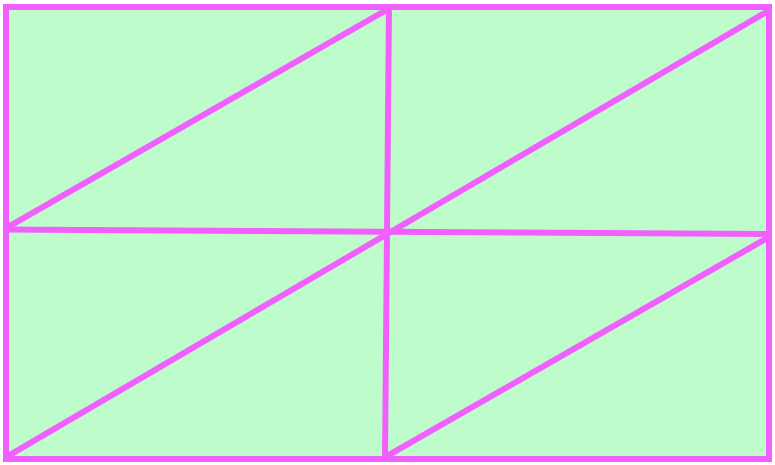
Step I: Draw a rectangle and divide it as shown.
Step II: Now draw lines joining corners as shown.
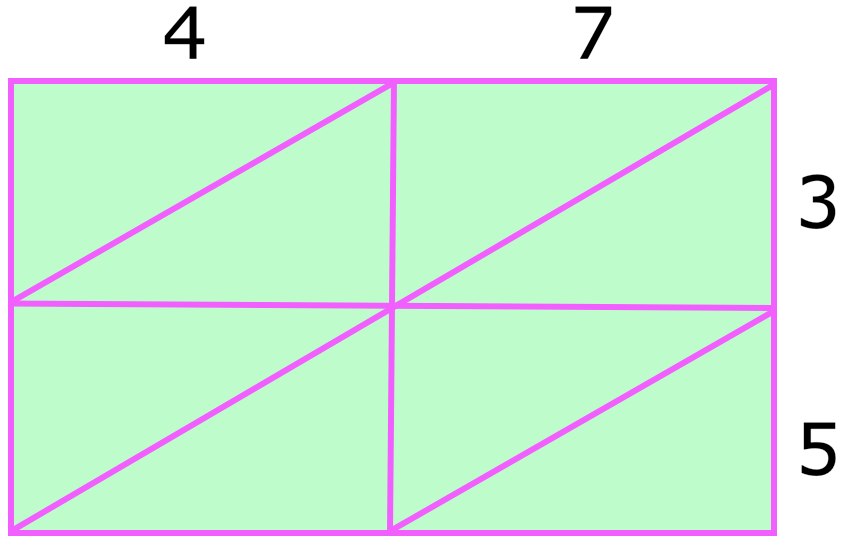
Step III: Suppose we multiply 47 by 35. Write 47 above the first row and 35 on the right hand side of the second column as shown.
Step IV: Multiply 7 by 3 you get 21. Write 2 in the upper half of the box and 1 in the lower half as shown. Now multiply 4 by 3, you will get 12. Again write 1 in the upper half and 2 in the lower half.

Step V: Now multiply 7 by 5, you will get 35. Write 3 in upper half and 5 in lower half as shown. In the same way, write 4 × 5 = 20.
Step VI: Starting from the lower most column, add the numbers diagonally from the bottom left corner to the right corner as shown by arrows. Write the sum, if any, on bottom and left side of the box.
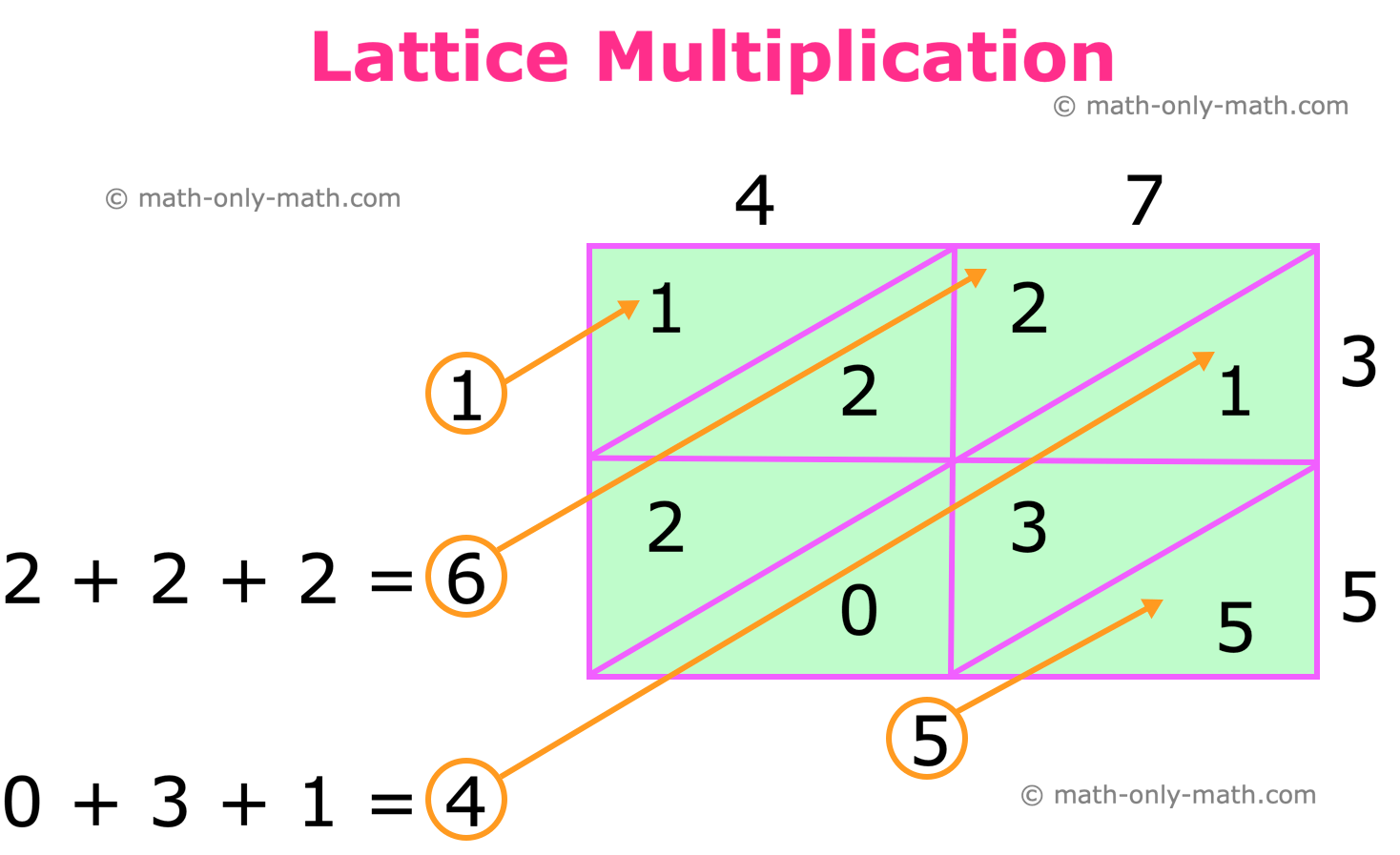
Step VII: The answer is 1645.
Conventional Method of Lattice Multiplication:
Now you can check this with the conventional method of multiplication.
Objective: To verify multiplication in the lab by Lattice multiplication algorithm.
Materials Required: White sheet of paper, red pencil and blue pencil.
Procedure:
1. Take a white sheet of paper and draw a box as shown in fig (i)
2. Write 34 and 3 – the multiplicand and multiplier as shown in fig (ii)
3. Multiply 4 by 3 and write the product 12 in the box headed by 4 as shown in fig (iii)
4. Multiply 3 by 3 and write the product in the box headed by 3. Write 9 as 09 (Using ‘0’ on the left) in two digits as shown in Fig. (iv)
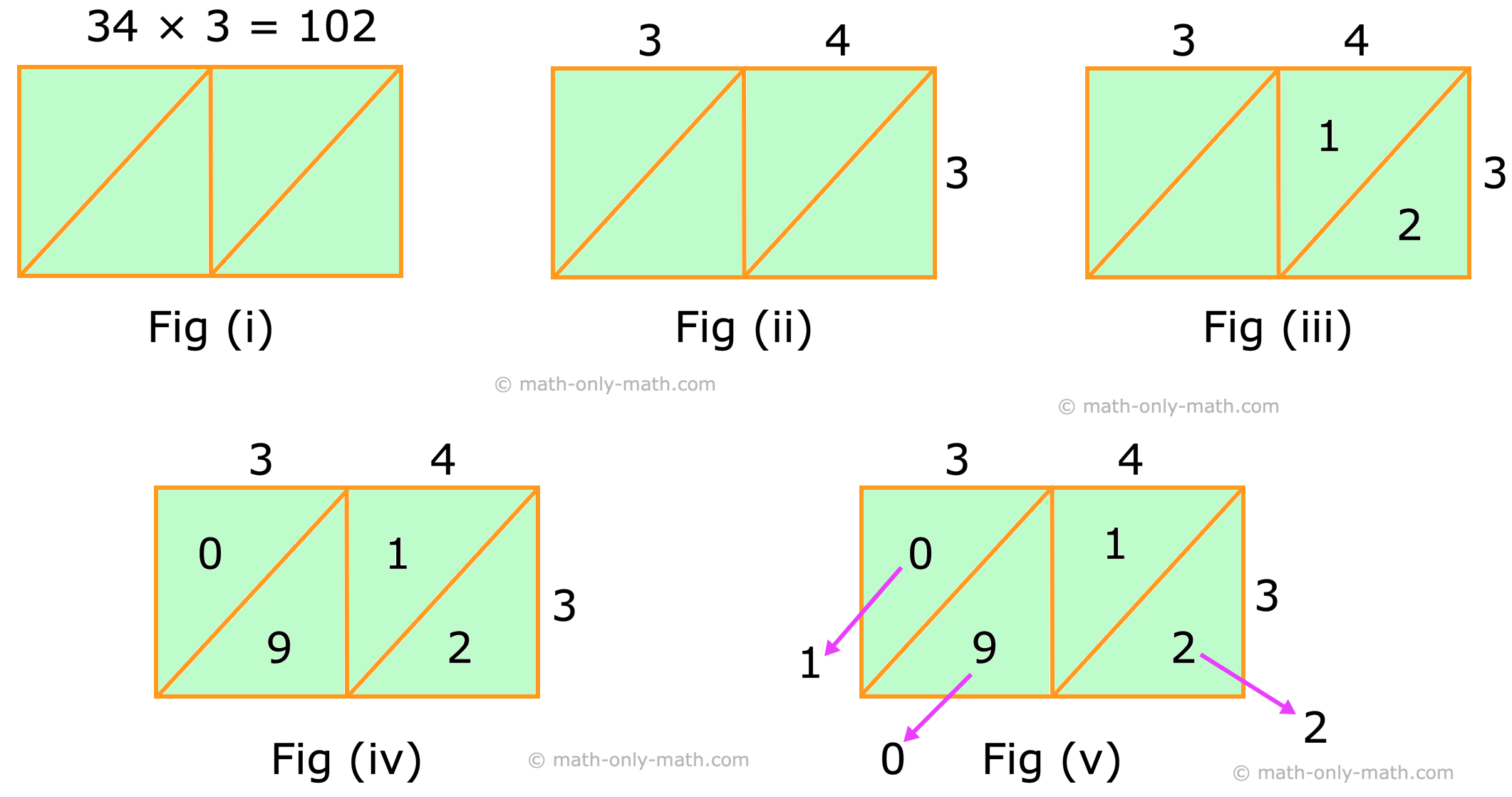
5. Add the numbers in slanting position and write the sum in front of the numbers as shown in fig. (v).
First sum = 2
Second sum = 1 + 9 = 10, write 0 and carry 1 to the next block
Last sum = 1 + 0 = 1
The product of the numbers obtained by writing the digits taken in the anticlockwise direction i.e., 102.
Note: Lattice multiplication was introduced in Europe by Leonardo Fibonacci around the year 1202, although similar methods were used in India and the Middle East many centuries earlier.
Worksheet on Lattice Multiplication:
1. Solve the following using lattice multiplication and check your answers:
(i) 28 × 12
(ii) 43 × 18
(iii) 64 × 21
(iv) 68 × 15
Answer:
1. (i) 336
(ii) 774
(iii) 1344
(iv) 1020
Frequently Asked Questions (FAQs) on Lattice Multiplication:
Answer:
Lattice multiplication is a visual method of multiplying two or more numbers using a grid divided by diagonal lines. Each digit is multiplied separately, and the partial products are added along the diagonals to find the final answer.
Answer:
Lattice multiplication organizes each step inside a grid, making it easier to keep track of place values and reducing calculation mistakes. It is especially helpful for students who are learning multi-digit multiplication.
Answer:
First, draw a lattice grid based on the number of digits. Write one number across the top and the other down the side. Multiply each pair of digits and write the tens and ones in each box. Finally, add the numbers along the diagonals to get the product.
Answer:
Yes. The lattice method works for 2-digit, 3-digit, 4-digit, and even larger numbers. You simply make a larger grid with the correct number of rows and columns.
Answer:
The lattice method helps students organize their work, understand place value, reduce carrying errors, and solve multiplication problems with greater confidence.
Answer:
Neither method is better for everyone. Lattice multiplication is often easier for beginners because the grid keeps the calculations organized, while long multiplication may become faster with practice.
Answer:
Lattice multiplication became popular in Europe through Leonardo Fibonacci in the early 13th century, although similar methods had been used earlier in India and the Middle East.
Answer:
Many schools introduce lattice multiplication in Grades 4 and 5, after students have mastered basic multiplication facts and place value.
Answer:
Yes. The multiplication process is the same as for whole numbers. After finding the product, place the decimal point by counting the total number of decimal places in the factors.
Answer:
The best way to learn lattice multiplication is by solving step-by-step examples, completing worksheets, and using interactive practice activities. Regular practice helps improve both speed and accuracy.
3rd Grade Math Worksheets
3rd Grade Math Lessons
From Lattice Multiplication to HOME PAGE
Didn’t find what you were looking for? Or want to know more information
about Math Only Math.
Use this Google Search to find what you need.

You may also like

Patterns Worksheets | Number Patterns & Patterns in Math
Free HCF and LCM Worksheet with Answers (Printable PDF)