This 700-Meter Space Rock Spins So Fast It Should Be Dust by Now
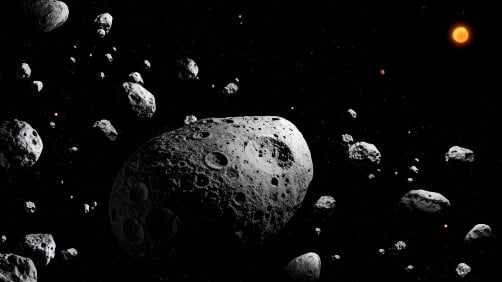
Picture a boulder eight football fields wide, tumbling through the void between Mars and Jupiter. Now imagine it completing a full rotation every 112 seconds. By everything astronomers thought they knew about asteroids, this thing should have ripped itself apart millions of years ago.
It didn’t.
The object is called 2025 MN45, and it’s forcing scientists to rethink what space rocks are actually made of. A team using the new Vera C. Rubin Observatory in Chile spotted it during early test runs of the facility’s massive camera. At 710 meters across, it’s now the fastest-spinning asteroid over 500 meters ever recorded.
Most asteroids aren’t solid hunks of stone. They’re rubble piles, loose collections of rock and dust held together by weak gravity. Spin one too fast and centrifugal force tears it apart. The theoretical limit for large asteroids sits around one rotation every 2.2 hours.
2025 MN45 spins nearly 70 times faster than that.
The Physics Don’t Add Up
To survive at this rotation rate, the asteroid must have internal cohesion closer to solid rock than to a gravitationally bound debris pile. The team’s calculations suggest material strength far exceeding what’s typical for main-belt objects.
“Clearly, this asteroid must be made of material that has very high strength in order to keep it in one piece as it spins so rapidly,” Sarah Greenstreet explains.
Greenstreet, an astronomer at NSF NOIRLab and lead researcher on the study, published the findings in The Astrophysical Journal Letters. Its the first peer-reviewed study to use data from Rubin’s LSST Camera, the largest digital camera ever built.
The discovery wasn’t a fluke. During just ten hours of observations spread across seven nights in early 2025, the team identified 19 super-fast rotators. These are objects spinning faster than the 2.2-hour fragmentation threshold. Most turned up in the main asteroid belt, a region where such finds were nearly impossible before Rubin came online.
Distance made detection difficult. Main-belt asteroids appear far fainter than near-Earth objects. Rubin’s light-collecting power changes that equation.
What Fast Spin Tells Us
Rotation rates serve as fossil records. A violent collision can send an asteroid spiraling. Solar radiation pressure can gradually spin objects up over millions of years. Either way, fast rotation hints at unusual internal structure or a chaotic past.
Finding 19 of these speedsters in such a short observation window suggests they’re more common than anyone expected. The Rubin Observatory hasn’t even started its official survey yet.
That survey, called the Legacy Survey of Space and Time, will run for ten years. Scientists expect it to catalog up to 5 million small bodies in our solar system. If early results are any indication, the next decade will turn up objects that challenge basic assumptions about planetary physics.
For now, 2025 MN45 stands as a reminder that familiar territory can still suprise us. Something that size, spinning that fast, remaining intact. It shouldn’t work.
And yet there it is, tumbling through the dark.
The Astrophysical Journal Letters: 10.3847/2041-8213/ae2a30
If our reporting has informed or inspired you, please consider making a donation. Every contribution, no matter the size, empowers us to continue delivering accurate, engaging, and trustworthy science and medical news. Independent journalism requires time, effort, and resources—your support ensures we can keep uncovering the stories that matter most to you.
Join us in making knowledge accessible and impactful. Thank you for standing with us!