
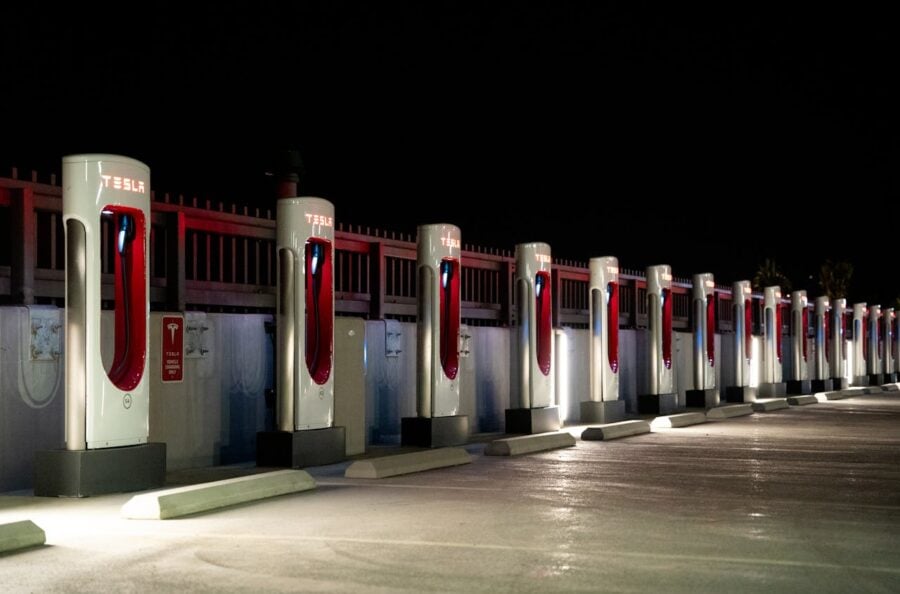
Electric Vehicle Chargers Can Either Strain Or Stabilize The Grid
Behind every quick EV top up, the power grid is working harder than most drivers ever realize.
In a new experimental modeling study published August 25 2025 in the journal Green Energy and Intelligent Transportation (Beijing Institute of Technology Press), Nitin Kumar Saxena of Teerthanker Mahaveer University in India and David Wenzhong Gao of the University of Denver simulate a 180 kW commercial charging station and show that a distribution static compensator, or D STATCOM, can enhance power quality by mitigating load imbalance from a random electric vehicle fleet at electric vehicle charging stations.
The problem starts with how real charging stations actually work. Drivers do not arrive in neat shifts or plug into carefully assigned ports. They show up whenever they need energy, grab whatever charging gun is free, and leave on their own schedule. In a three phase low voltage distribution network, that randomness creates lopsided demand, some phases carry much more current than others, and the result is voltage drops, distorted waveforms, and extra losses that quietly eat into the grid s ability to host more chargers and renewables.
To capture this, the authors build a detailed model of a 180 kW electric vehicle charging station. The site includes a 15 kW base load for operations plus fifteen 11 kW charging guns at 240 V and 60 Hz, arranged across three phase pairs. Using MATLAB, they generate a random fleet of electric vehicles and track, hour by hour over a full day, which guns are occupied. In the baseline case, vehicles simply connect wherever space is available, and the uneven occupancy produces strong imbalances in real and reactive power among the three phases, along with higher current harmonic distortion and more severe transients during plug in and plug out events.
When Random Charging Turns Into Grid Noise
The team places this problem in the wider context of EV charging research, which has already explored where to locate stations, how large to make them, how to predict traffic with machine learning, and how to integrate solar, storage, and smart pricing. Here, the focus narrows to a specific but important question. What happens to power quality when a random EV fleet hits a commercial charging station fed by a low voltage distribution network, and how much can better load balancing and local reactive power support help.
As the random fleet fills and empties charging guns, the three phases see different currents and different power factors. Inductive EV loads at a lagging power factor demand reactive power as well as real power, and if nothing compensates locally, the distribution network must supply both. That extra reactive flow raises losses and can push voltages outside recommended limits, especially during peak hours. The authors summarize the challenge bluntly.
This creates imbalances in power demand, leading to issues like voltage drops, harmonic distortions, and overall poor power quality that could hinder widespread EV integration.
To measure how serious that is, the study tracks standard indicators such as total current harmonic distortion, current imbalance factors, and voltage imbalance factors. In the random baseline case, current imbalance can climb to around a quarter of the positive sequence component, and transient effects are more pronounced whenever vehicles plug in or out. Even if the total daily energy delivered is the same, the way that power is distributed across the three phases makes a major difference to how gracefully the grid can handle it.
Turning Charging Hubs Into Quiet Grid Helpers
The solution in the paper comes in two parts. First, Saxena and Gao keep the same total EV load but actively rearrange which guns are used when, so that the three sets of chargers tied to each phase pair share the burden more evenly. Second, they add a D STATCOM, a power electronics device that injects or absorbs reactive power at the charging station itself. With a tuned current controller, LCL filter, and converter, the D STATCOM is modeled to supply up to plus or minus 120 kVAR, so the low voltage distribution network can focus on delivering real power while the station handles its own reactive needs.
Once both pieces are in place, the simulations show a cleaner picture. Load currents in each phase drop and become more similar, which cuts resistive losses. Total current harmonic distortion at the charging station stays below about 5 percent, with smaller spikes during busy times. Current imbalance falls from peaks around 26 percent in the random case to values closer to 5 to 10 percent with the proposed scheduling, and voltage imbalance shrinks as well, in line with international standards. Frequency remains tightly regulated even with frequent plug in and plug out events, and transient disturbances are reduced.
The authors then test robustness by overlaying seasonal load profiles based on a Colorado utility rate sheet, modeling winter and summer peak and off peak patterns for a station in Denver Colorado. In winter, most of the EV traffic clusters in the evening hours; in summer, it shifts toward midday and afternoon. In both seasons, the combination of load reallocation and D STATCOM reactive power support keeps harmonic distortion and imbalance within accepted limits, even when a large random fleet of vehicles arrives during peak hours.
This study innovates by tackling the hidden hurdles of EV adoption head-on, using D-STATCOM to conquer load imbalances and elevate power quality at charging stations. Its contributions, from proven models to real-world applicability, herald a future where EVs do not just replace gas guzzlers but enhance our entire energy landscape, fostering a cleaner, more efficient world for generations to come.
The practical implications extend beyond one simulated station. If commercial charging hubs can quietly manage their own phase balance and reactive power, utilities may be able to defer some infrastructure upgrades, and grid operators could treat stations as partners that help support voltage rather than as passive sources of stress. For drivers, better power quality shows up as chargers that are more reliable during peaks and more likely to scale smoothly as electric vehicle adoption increases.
The paper points to next steps such as using machine learning to predict charging gun occupancy, integrating economic models for ancillary services, and exploring how these techniques can coexist with future vehicle to grid schemes. The broader lesson is simple. Treating EV charging stations as smart, actively controlled nodes, rather than just new loads, can turn a source of grid noise into a flexible asset that helps make electric mobility and cleaner power systems grow together.
Green Energy and Intelligent Transportation: 10.1016/j.geits.2024.100222
Related
Discover more from SciChi
Subscribe to get the latest posts sent to your email.