Multiply 3-Digit Number by 1-Digit Number
Subscribe to our ▶️ YouTube channel 🔴 for the latest videos, updates, and tips.
Here we will learn
multiplying 3-digit number by 1-digit number.
Learning how to multiply a 3-digit number by a 1-digit number is an important math skill that helps students solve everyday problems quickly and accurately. In this lesson, you will learn the step-by-step method to multiply three-digit numbers by one-digit numbers using easy examples. Whether you are practicing multiplication without regrouping or multiplication with regrouping (carrying), this guide will help you understand each step clearly.
How do you multiply a 3-digit number by a 1-digit number?
Multiply the ones first, then the tens, and finally the hundreds. If any product is greater than 9, carry the extra digit to the next place value. Continue until all digits have been multiplied. This method works for multiplication with and without regrouping.
In two different types we will learn to multiply a three-digit number by a one-digit number.
A. Multiplication of 3-digit Number by 1-digit Number without Regrouping:
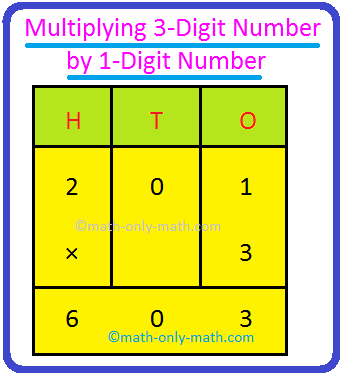
1. Multiply 201 by 3
|
Step I: Arrange the numbers vertically. Step II: Multiply the digit at the ones place by 3. 1 × 3 = 3 ones Step III: Now multiply the digit at the tens place by 3. 0 × 3 = 0 tens Step IV: Now multiply the digit at the hundreds place by 3. 2 × 3 = 6 hundreds |
Thus, 201 × 3 = 603 |
2. Multiply 221 by 2.
|
H T O 2 2 1 × 2 4 4 2 |
First-Multiply ones by 2. 2 × 1 = 2. write 2 under O. Then-Multiply tens by 2. 2 × 2 = 4, write 4 under T. At last-Multiply hundreds by 2. 2 × 2 = 4. write 4 under H. Thus, 221 × 2 = 442 |
Multiply 3-Digit Number by 1-Digit Number Video
MULTIPLICATION OF A 3-DIGIT NUMBER BY A 1-DIGIT NUMBER WITHOUT REGROUPING:
3. Let us multiply 132 by 3.
Write the numbers one below the other as shown.
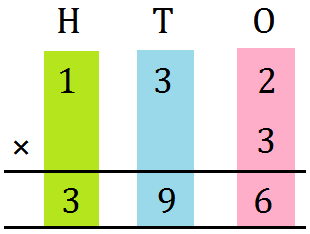
Step I: Multiply the ones digit by 3.
2 ones × 3 = 6 ones
Write 6 in the ones place.
Step II: Multiply the tens digit by 3.
3 tens × 3 = 9 tens
Write 9 in the tens place.
Step III: Multiply the hundreds digit by 3.
1 hundred × 3 = 3 hundreds
Write 3 in the hundreds place.
The product is 396.
Multiply 3-Digit Number by 1-Digit Number Short Video
Word Problems on Multiplication of a 3-digit Number by a 1-digit Number Without Regrouping:
4. Nairitee used 134 beads in a necklace. How many beads will she be used to make 2 necklaces?
134 × 2 = ?
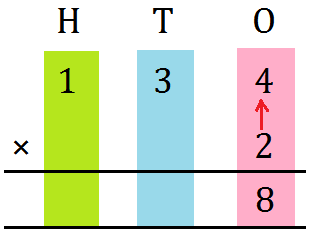
Step I: Arrange the numbers in correct columns.
Multiply the digit in the ones place by 2.
4 ones × 2 = 4 × 2 = 8 or 8 ones
Write 8 in the ones column.
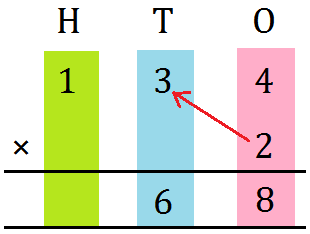
Step II: Multiply the digit in the tens place by 2.
3 tens × 2 = 30 × 2 = 60 or 6 tens
Write 6 in the tens column.
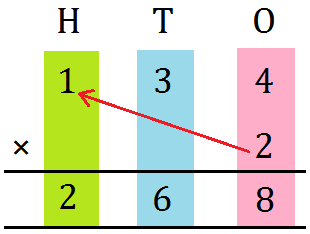
Step III: Multiply the digit in the hundreds place by 2.
1 hundred × 2 = 100 × 2 = 200 or 2 hundreds
Write 2 in the hundreds column.
So, 134 × 2 = 268
Thus, she will use 268 beads.
You know how we multiply two digit number by one digit number. In the same way we can multiply 3-digit number by one digit number.
5. Multiply 243 by 2.
Solution:
Multiply each place in turn. Start with ones place.
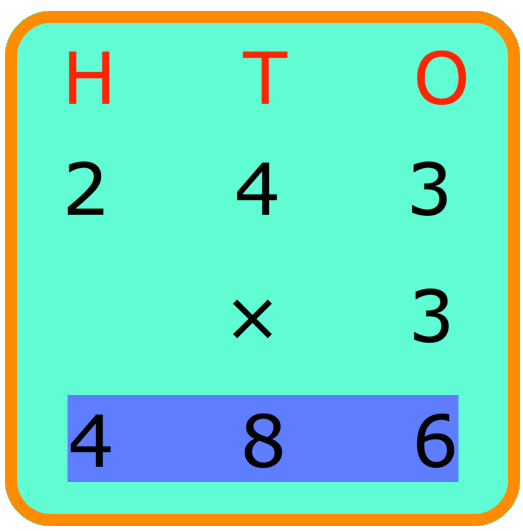 |
Step I: 3 × 2 = 6 Ones Write 6 in ones column Step II: 4 × 2 = 8 Tens Write 8 in tens column Step III: 2 × 2 = 4 Hundreds Write 4 in hundreds column The product = 486 |
6. Let us multiply 234 by 2.
Solution:
Method A: Using the expanded form of multiplicand:
234 = (200 + 30 + 4) × 2
= (200 × 2) + (30 × 2) + (4 × 2)
= 468
= 400 + 60 + 8

Method B: Short method
Step I: Arrange the numbers as shown on the right.
Step II: Multiply the ones.
2 × 4 ones = 8 ones
Write 8 in the ones place.
Step III: Multiply the tens.
2 × 3 tens = 6 tens
Write 6 in the tens place.
Step IV: Multiply the hundreds.
2 × 2 hundreds = 4 hundreds.
Write 4 in the hundreds place.
B. Multiplication of 3-digit Number by 1-digit Number with Regrouping:
1. Multiply 246 by 4
|
Step I: Arrange the numbers vertically. Step II: Multiply the digit at the ones place by 4. 6 × 4 = 24 = 2 tens + 4 ones Write 4 in the ones column and carry over 2 to the tens Step III: Now multiply the digit at the tens place by 4. 4 × 4 = 16 tens Now, 16 + 2 (carry over) = 18 tens = 1 hundred + 8 tens Step IV: Now multiply the digit at the hundreds place by 4. 2 × 4 = 8 hundreds Now, 8 + 1 (carry over) = 9 hundred |
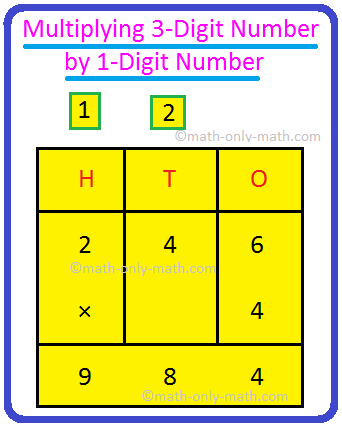 Thus, 246 × 4 = 984 |
2. Multiply 453 by 6.
|
Step I: Arrange the numbers vertically. Step II: Multiply the digit at the ones place by 6. 6 × 3 = 18 = 1 tens + 8 ones Write 8 in the ones column and carry over 1 to the tens Step III: Now multiply the digit at the tens place by 6. 6 × 5 = 30 tens Now, 30 + 1 (carry over) = 31 tens = 3 hundred + 1 tens Write 1 in the tens column and carry over 3 to the hundred
Step IV: Now multiply the digit at the hundreds place by 6. 6 × 4 = 24 hundreds Now, 24 + 3 (carry over) = 27 hundreds = 2 thousands and 7 Write 7 at the tens place and 2 at the thousands place. |
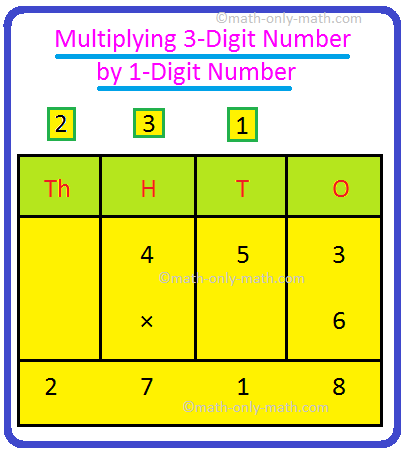 Thus, 453 × 6 = 2718 |
3. Multiply 167 by 2.
|
H T O 1 1 1 6 7 × 2 3 3 4 |
7 × 2 = 14 = 1 ten + 4 ones. write 4 under O. Carry 1 ten. 6 × 2 = 12 + 1 = 13 13 = 1 hundred + 3 tens. write 3 under T. Carry 1 hundred. 2 × 1 = 2 + 1 = 3 write 3 under H. |
4. Multiply 294 by 4.
|
Step I: Align the digits: |
Th H T O 2 9 4 × 4
|
|
Step II: Multiply ones. 4 ones × 4 = 16 ones 1 tens 6 ones. Write 6 below ones place and carry 1 to the tens place. |
Th H T O 1 2 9 4 × 4 6 |
|
Step III: Multiply tens. 9 tens × 4 = 36 tens. 36 tens + 1 tens (carried) = 37 tens = 3 hundreds + 7 tens Write 7 below tens place and carry over 3 to the hundreds place. |
Th H T O 3 1 2 9 4 × 4 7 6 |
|
Step IV: Multiply hundreds. 2 hundreds × 4 = 8 hundreds. 8 hundreds + 3 hundreds (carried) = 11 hundreds Write 1 in hundreds place and 1 in thousands place. |
Th H T O 3 1 2 9 4 × 4 1 1 7 6 |
Hence, 294 by 4 = 1,176
5. Multiply 239 by 8.
|
Step I: Th H T O 2 3 9 × 8
|
Step II: Th H T O 7 2 3 9 × 8 2 |
|
Step III: Th H T O 3 7 2 3 9 × 8 1 2 |
Step IV: Th H T O 3 7 2 3 9 × 8 1 9 1 2 |
Therefore, 239 × 8 = 1,912
6. Let us multiply 123 by 4.
Write the numbers one below the other as shown.
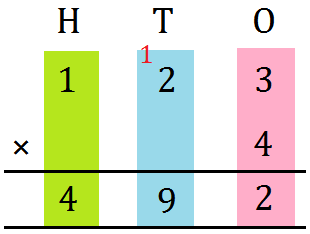
Step I: Multiply the ones digit by 4.
3 ones × 4 = 12 ones
Regroup: 12 ones = 1 ten and 2 ones
Write 2 in the ones place.
Carry over 1 ten and write it under T.
Step II: Multiply the tens digit by 4.
2 tens × 4 = 8 tens
Add 8 tens and 1 ten (carried over).
8 tens + 1 ten = 9 tens
Write 9 in the tens place.
Step III: Multiply the hundreds digit by 4.
1 hundred × 4 = 4 hundreds
The product is 492.
7. Multiply 542 by 3.
Solution:
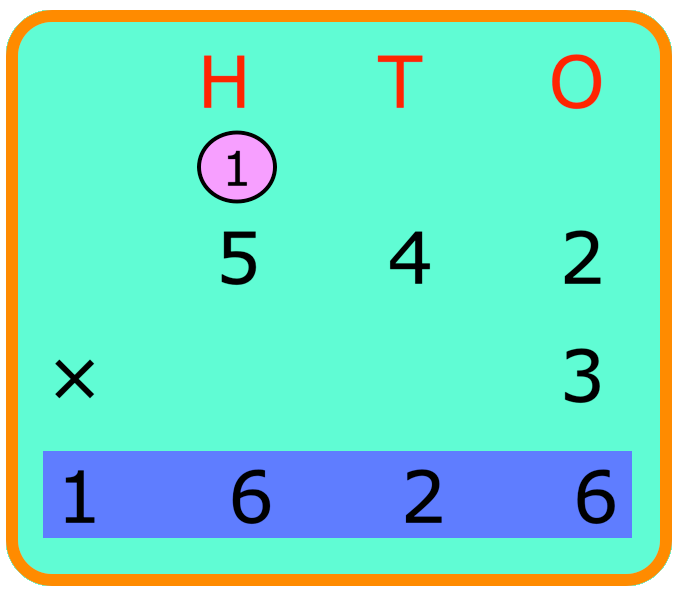 |
Step I: 2 × 3 = 6 Ones Write 6 in ones column Step II: 4 × 3 = 12 Tens Write 2 in tens column and carry 1 to the hundreds column Step III: 5 × 3 = 15 hundreds Add 15 hundreds and 1 hundred (carried over). 15 hundreds and 1 hundred = 16 hundreds Write 6 in hundreds column and take 1 to the thousands column The product=1626. |
Multiplying 3-Digit Number by 1-Digit Number with Regrouping Twice:
8. Let us multiply 145 by 3.
Write the numbers one below the other as shown.
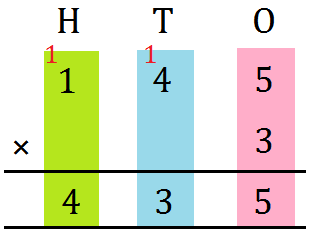
Step I: Multiply the ones digit by 3.
5 ones × 3 = 15 ones
Regroup: 15 ones = 1 ten and 5 ones
Write 5 in the ones place.
Carry over 1 ten and write it under T.
Step II: Multiply the tens digit by 3.
4 tens × 3 = 12 tens
Add 12 tens and 1 ten (carried over).
12 tens + 1 ten = 13 tens
Regroup: 13 tens = 1 hundred and 3 tens
Write 3 in the tens place.
Carry over 1 hundred and write it under H.
Step III: Multiply the hundreds digit by 3.
1 hundred × 3 = 3 hundreds
Add 3 hundreds and 1 hundred (carried over).
3 hundreds + 1 hundred = 4 hundreds
Write 4 in the hundreds place.
The product is 435.

9. Multiply 138 by 5.
Solution:
Step I: Arrange the numbers as shown.
Step II: Multiply the ones.
8 ones × 5 = 40 ones
Write 0 in the ones column and carry over 4 to the tens column.
Step III: Multiply the tens.
3 tens × 5 = 15 tens
15 tens + 4 tens (carried over) = 19 tens
Write 9 in the tens column and carry over 1 to the hundreds column.
Step IV: Multiply the hundreds.
1 hundred × 5 = 5 hundreds
5 hundreds + 1 hundred (carried over) = 6 hundreds
Write 6 in the hundreds column.
Therefore, 138×5 = 690.
Word Problems on Multiplying a 3-digit Number by a 1-digit Number with Regrouping:
10. There are 235 books in one rack. How many books can 4 such racks hold?
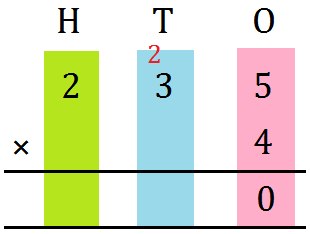
Step I: Multiply the digit in the ones place by 4.
5 × 4 = 20
20 is a 2-digit number, keep 0 in the ones column and carry over 2 to the tens column.

Step II: Multiply the digit in the tens place by 4.
Add the carried over number to the result.
3 × 4 = 12
12 + 2 = 14
Keep 4 in the tens column and carry over 1 to the hundreds column.
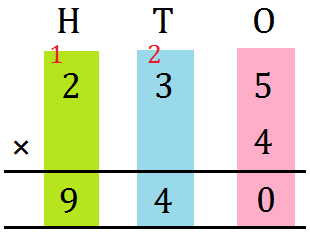
Step III: Multiply the digit in the hundreds place by 4.
Add the carried over number to the result.
2 × 4 = 8
8 + 1 = 9
Write 9 in the hundreds column.
So, 4 racks can hold 940 books.
Play Multiplication Challenge Game:
🌟 Multiplication Star Challenge 🌟
Question 1 of 8
Score: 0/8
Stars: —
Your Review
| Question | Your Answer | Correct Answer |
|---|
Worksheet on Multiplying 3-Digit Number by 1-Digit Number:
Multiplying 3-Digit Number by 1-Digit Number without Regrouping:
I. Multiply the following:
(i) 134 × 2
(ii) 320 × 3
(iii) 112 × 4
(iv) 301 × 2
(v) 202 × 2
(vi) 131 × 3
(vii) 220 × 4
(viii) 303 × 3
Answer:
I. (i) 268
(ii) 960
(iii) 448
(iv) 602
(v) 404
(vi) 393
(vii) 880
(viii) 909
Multiplying 3-Digit Number by 1-Digit Number with Regrouping:
II. Multiply the following:
(i) 237 × 4
(ii) 142 × 7
(iii) 235 × 4
(iv) 408 × 2
(v) 145 × 6
(vi) 126 × 3
(vii) 435 × 2
(viii) 157 × 5
Answer:
II. (i) 948
(ii) 994
(iii) 940
(iv) 816
(v) 870
(vi) 378
(vii) 870
(viii) 785
III. Multiply the following:
(i) 467 × 8
(ii) 706 × 7
(iii) 982 × 9
(iv) 351 × 6
(v) 738 × 5
(vi) 288 × 7
Answer:
III. (i) 3736
(ii) 4942
(iii) 8838
(iv) 1806
(v) 3690
(vi) 2016
IV. Multiply the Following 3-Digit Numbers by 1-Digit Number:
|
(i) H T O 3 1 3 × 2 _ |
(ii) H T O 8 6 6 × 1 _ |
|
(iii) H T O 2 1 0 × 3 _ |
(iv) H T O 0 0 3 × 2 _ |
|
(v) H T O 1 1 7 × 1 _ |
(vi) H T O 1 1 4 × 4 _ |
|
(vii) H T O 2 1 5 × 3 _ |
(viii) H T O 1 1 2 × 6 _ |
|
(ix) H T O 1 2 3 × 4
|
(x) H T O 3 0 3 × 7 _ |
|
(xi) H T O 1 7 4 × 3
|
(xii) H T O 2 8 5 × 8
|
|
(xii) H T O 2 3 4 × 4 _ |
(xiv) H T O 3 3 2 × 6
|
|
(xv) H T O 4 5 2 × 5 _ |
V. Multiply and Fill in the Blanks:
(i) 222 × 3 = _____
(ii) 212 × 4 = _____
(iii) 323 × 2 = _____
(iv) 112 × 5 = _____
(v) 124 × 4 = _____
(vi) 225 × 9 = _____
(vii) 666 × 6 = _____
(viii) 444 × 5 = _____
(ix) 245 × 7 = _____
(x) 145 × 4 = _____
Play Interactive Multiplication Quiz:
3-Digit × 1-Digit Multiplication Quiz
About Author

Written by Priyanka Ghosh
Mathematics Educator | Founder of Math Only Math
Priyanka Ghosh has been teaching elementary and middle-school mathematics for over 12 years and specializes in creating simple, child-friendly math lessons and worksheets.
Answer:
A 3-digit number is a number that has three digits. It starts from 100 and ends at 999. Every 3-digit number has a hundreds, tens, and ones place.
For example: 245, 378, and 901 are 3-digit numbers.
Answer:
To multiply a 3-digit number by a 1-digit number, start multiplying from the ones place. Then multiply the tens and hundreds digits. If a product is 10 or more, carry the extra digit to the next place value. Continue until all digits have been multiplied and write the final answer.
Answer:
Regrouping in multiplication, also called carrying, happens when the product of two digits is 10 or greater. The tens digit is carried to the next place value, while the ones digit is written in the current place. Regrouping helps keep the place values correct.
Answer:
You carry in multiplication whenever the product of two digits, or the product plus any carried number, is 10 or more. The extra tens are carried to the next place value to get the correct answer.
Answer:
Yes. A 3-digit × 1-digit multiplication can produce a 4-digit answer. For example, 345 × 3 = 1035, which is a 4-digit number. However, not every multiplication gives a 4-digit product. It depends on the numbers being multiplied.
3rd Grade Math Lessons
From Multiplying 3-Digit Number by 1-Digit Number to HOME PAGE
Didn’t find what you were looking for? Or want to know more information
about Math Only Math.
Use this Google Search to find what you need.

You may also like

Patterns Worksheets | Number Patterns & Patterns in Math
Free HCF and LCM Worksheet with Answers (Printable PDF)