Estimate to Nearest Hundreds – Easy Rounding Rules, Examples,Worksheet
Subscribe to our ▶️ YouTube channel 🔴 for the latest videos, updates, and tips.
Before learning nearest hundreds, understand rounding to nearest tens.
Estimating to the nearest hundreds means rounding a given number to the closest hundred. It helps us find an approximate value quickly and makes mental calculation easier.
When we estimate a number to the nearest hundred, we check the tens digit of the number and decide whether to round the number down or round it up.
This method is widely used in:
- Quick addition and subtraction,
- Rough multiplication,
- Mental math,
- Checking reasonable answers,
- Everyday calculations.
In this lesson, we will learn the easy rule for rounding to the nearest hundred, solved examples, number line explanation, and practice worksheet questions.
What Does “Estimate to Nearest Hundreds” Mean?
Estimating to the nearest hundreds means rounding a number to the closest multiple of 100.
This makes calculations easier and faster, especially in mental math.
For Example:
Easy Rule for Estimating to Nearest Hundreds:
To estimate or round off a number to the nearest hundred, follow these simple steps:
Step I: Look at the tens digit of the given number.
Step II: If the tens digit is 0, 1, 2, 3, or 4, round the number down to the previous hundred.
Step III: If the tens digit is 5, 6, 7, 8, or 9, round the number up to the next hundred.
Step IV: Change the tens digit and ones digit to zero.
0 to 4 → Round Down ⬇ | 5 to 9 → Round Up ⬆
This is the basic rounding rule used for nearest hundred estimation.
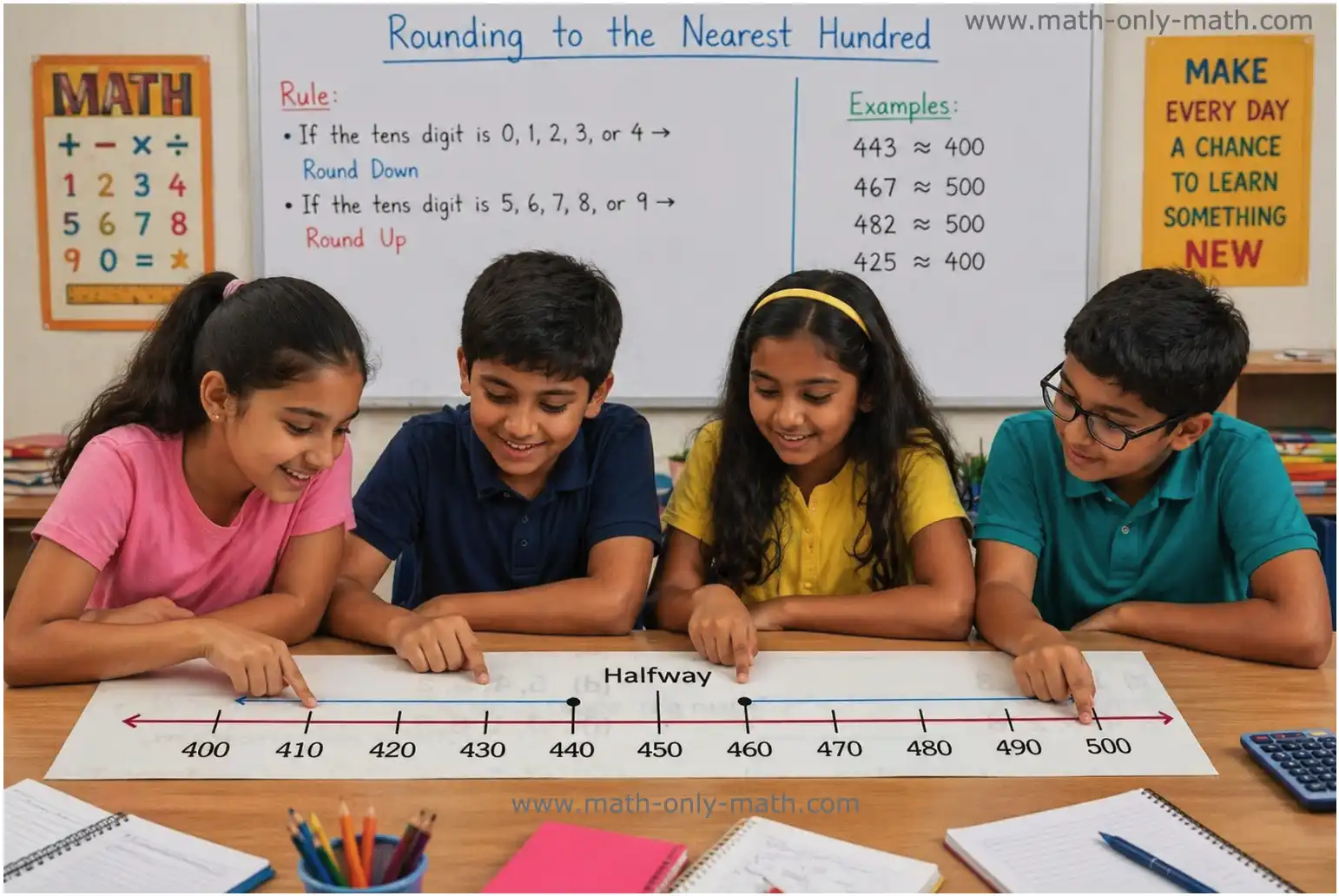
The numbers that are halfway or above are rounded off to the next 100 and the numbers that are less than halfway are rounded off to the existing 100.
For Example:
(i) 440 is closer to 400 (or less than halfway). So, it can be rounded down up to 400.
(ii) 460 is closer to 500 (or above the halfway). So, it can be rounded to 500.
(iii) 450 is closer to 500 (or at the halfway). So, it can be rounded up to 500.
Estimate to Nearest Hundreds GAME
🎯 Round to the Nearest Hundreds Game
Choose the correct nearest hundred and win points!
⭐ Score: 0
❤️ Lives: 5
🏆 Level: 1
Rule: Look at the tens digit. If it is 0–4 round down. If it is 5–9 round up.
0
Round this number to the nearest hundred:
Steps for Rounding to the Nearest Tens:
In order to estimate to nearest hundreds we follow the following procedure:
Step I: Obtain the number.
Step II: Examine the digit at tens place.
Step III: If the digit at tens place is less than 5, replace each one of the digits at tens and ones or units place by 0 and keep all other digits as they are.
If the digit at tens place is 5 or greater than 5, increase the digit at hundreds place by 1 and replace each one of the digits at tens and ones place by 0.
The number so obtained is the number rounded off to the nearest hundreds.
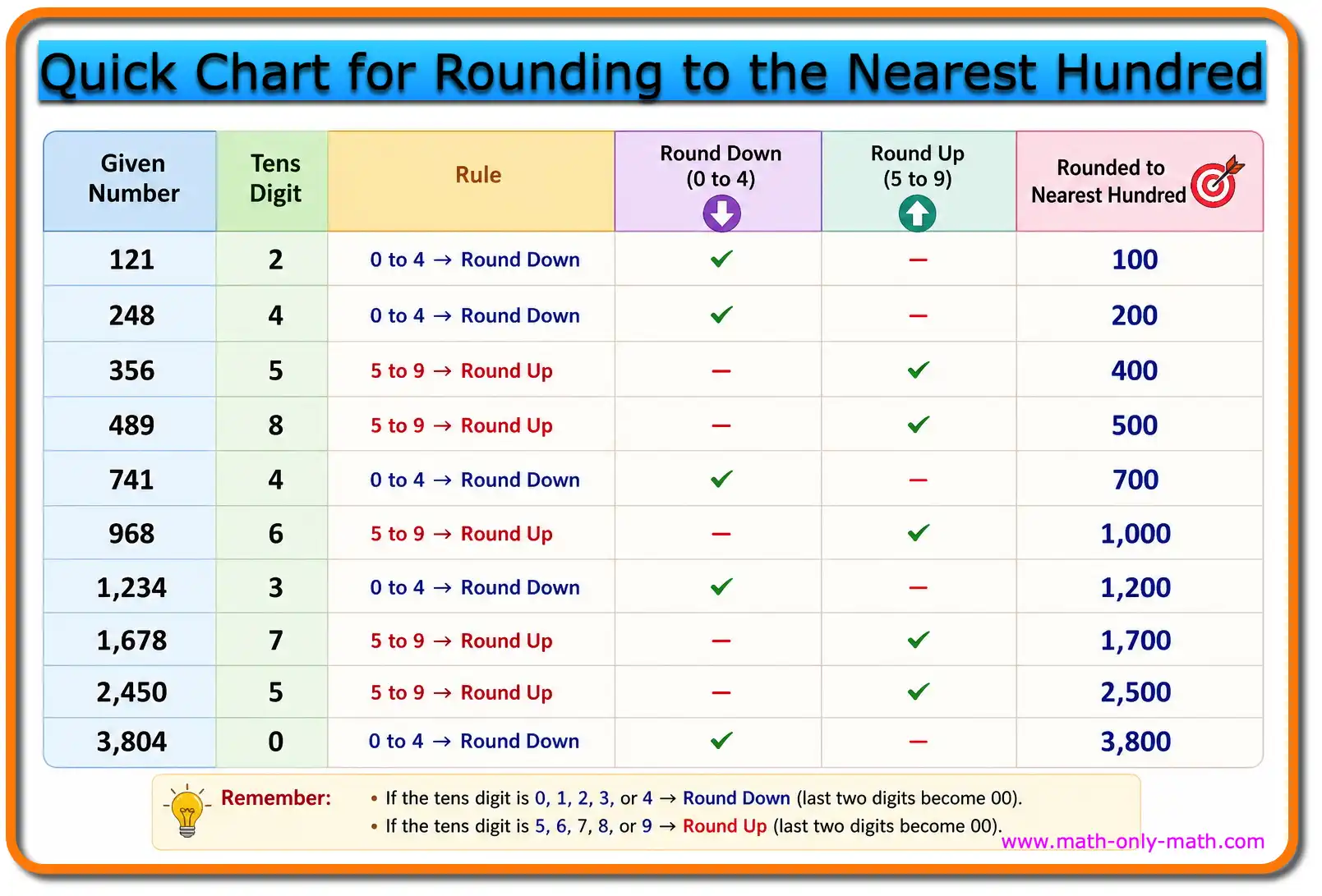
Chart for Rounding to the Nearest Hundred:
Use this quick chart to understand when to round down or round up to the nearest hundred.
Solved Examples on Estimating to Nearest Tens:
Let us consider some of the examples to estimate to nearest hundreds:
1. Round off each of the following numbers to nearest hundreds.
(i) 5839
Solution:
The given number is 5839.
Its
tens digit is 3, which is less than 5. So, we replace each of the tens
and ones digits by 0 and keep the other digits as they are to round off
the given number to nearest hundreds.
Hence, 5839 is rounded off to nearest hundreds as 5800.
(ii) 9472
Solution:
The given number is 9472.
Its
tens digit is 7, which is greater than 5. So, we increase the digits at
hundreds place by 1 and replace each one of the digits at tens and ones
place by 0 to round off the given number to nearest hundreds.
Hence, 9472 is rounded off to nearest hundreds as 9500.
(iii) 7456
Solution:
The given number is 7456.
Its
tens digit is 5. So, we replace each of the tens and ones digit by 0
and increase the hundreds digit by 1 to get the rounded off number to
the nearest hundred.
Hence, 7456 is rounded off to nearest hundreds as 7500.
2. Round 243 to the nearest hundred.
Solution:
- Tens digit = 4
- Since 4 is less than 5, round down.
Therefore, 243 ≈ 200
3. Round 278 to the nearest hundred.
Solution:
- Tens digit = 7
- Since 7 is greater than 5, round up.
Therefore, 278 ≈ 300
4. Round 654 to the nearest hundred.
Solution:
- Tens digit = 5
- Since 5 means round upward.
Therefore, 654 ≈ 700
5. Round 819 to the nearest hundred.
Solution:
- Tens digit = 1
- Since 1 is less than 5, round down.
Therefore, 819 ≈ 800
6. Round 999 to the nearest hundred.
Solution:
- Tens digit = 9
- Round upward to next hundred.
Therefore, 999 ≈ 1000
7. Round 1451 to the nearest hundred.
Solution:
- Tens digit = 5
- Round upward.
Therefore, 1451 ≈ 1500
8. Round 3204 to the nearest hundred.
Solution:
- Tens digit = 0
- Round down.
Therefore, 3204 ≈ 3200
9. Round 5876 to the nearest hundred.
Solution:
- Tens digit = 7
- Round upward.
Therefore, 5876 ≈ 5900
It follows from the above examples that
(i) the numbers ending in 01 to 49 are rounded off downwards.
(ii) the numbers ending in 50 to 99 are rounded off upwards.
Important Note:
If the digit in the tens place is 0, 1, 2, 3 or 4 we replace the digits in the tens and ones place by zero. If the digit in the tens place is 5, 6, 7, 8, or 9 we replace the digits in the tens and ones place by zeros. We also increase the digit in the hundreds place by 1.
CONCLUSION
Estimating to the nearest hundreds is a very useful math skill. We simply look at the tens digit, decide whether to round down or round up, and then change the last two digits to zero.
With enough practice, students can round numbers quickly and use estimation in all types of arithmetic calculations.
Practice Questions on Estimate to Nearest Hundreds:
1. Round each number to the nearest hundred:
(a) 167 = _____
(b) 452 = _____
(c) 791 = _____
(d) 1268 = _____
(e) 3401 = _____
(f) 5872 = _____
(g) 905 = _____
(h) 2499 = _____
(i) 630 = _____
(j) 118 = _____
Answers:
1. (a) 200
(b) 500
(c) 800
(d) 1300
(e) 3400
(f) 5900
(g) 900
(h) 2500
(i) 600
(j) 100
Related Estimation Lessons:
Students can also learn:
These lessons help build a complete understanding of rounding and estimation.
Frequently Asked Questions on Rounding to the Nearest Hundred:
Answer:
We check the tens digit.
Answer:
To round a number to the nearest hundred, look at the tens digit.
- If the tens digit is 0, 1, 2, 3, or 4, round down.
- If the tens digit is 5, 6, 7, 8, or 9, round up.
Then change the tens and ones digits to zero.
Answer:
We always check the tens digit when rounding to the nearest hundred because the tens digit tells us whether the number is closer to the lower hundred or the next hundred.
Answer:
The tens digit in 349 is 4.
Since 4 is less than 5, we round down.
So, 349 rounded to the nearest hundred is 300.
Answer:
The tens digit in 851 is 5.
Since 5 means round upward, the number is rounded to 900.
Answer:
0 to 4 → Round Down
5 to 9 → Round Up
If the tens digit is from 0 to 4, round the number down to the previous hundred.
If the tens digit is from 5 to 9, round the number up to the next hundred.
Answer:
450 is exactly halfway between 400 and 500.
By the standard rounding rule, numbers ending in 50 round upward.
So, 450 rounded to the nearest hundred is 500.
Answer:
Children can learn rounding to the nearest hundred easily by:
- checking the tens digit,
- using a number line,
- practicing simple examples,
- remembering the 0–4 and 5–9 rounding rule.
● Estimate
Estimate to Nearest Tens
Estimate to Nearest Hundreds
Estimate to Nearest Thousands
Estimating Sum and Difference
Estimating Product and Quotient
Numbers Page
6th Grade Page
From Natural Numbers to HOME PAGE
Didn’t find what you were looking for? Or want to know more information
about Math Only Math.
Use this Google Search to find what you need.

You may also like

Patterns Worksheets | Number Patterns & Patterns in Math
Free HCF and LCM Worksheet with Answers (Printable PDF)